
A friend tells you that "manga, manhwa, and manhua are all the same thing." Your friend is wrong — and in 2026 the difference is no longer linguistic. It is an industrial choice that decides what reaches your phone this week.
The three words share one root. The three industries belong to three different planets. This article unpacks the question across three layers — language, format, industry — and explains why the distinction suddenly matters for any reader opening a chapter on their phone.
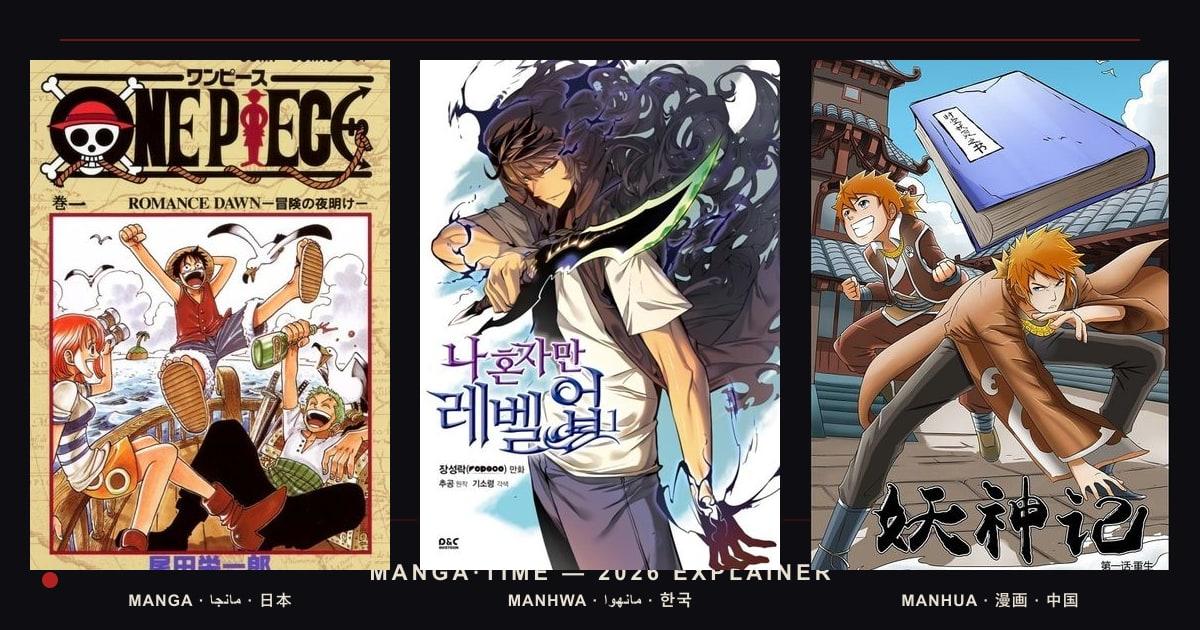
The first question every newcomer asks: are they really the same?
Linguistically, yes — almost. Manga, manhwa, and manhua all descend from the same Chinese root, 漫画, meaning roughly "free-flowing pictures" or "comics," per Wikipedia. One word, three pronunciations, a shared origin.
In 2026, though, that single word points to three industries that are geographically and commercially distinct: Japan, South Korea, China. The confusion persists because most readers reach the medium through aggregator sites that treat "manga" as a catch-all umbrella for anything drawn and serialized.
Manga — Japan, black and white, and the weekly magazine
Japanese manga is the commercial origin of the modern term. It is read right to left, top to bottom, and traditionally printed in black and white inside thick weekly magazines like Weekly Shōnen Jump, with chapters later collected into tankōbon volumes, per CBR.
The industrial model is slow and stubborn: one artist (with assistants), a weekly chapter, a punishing cadence, and a production life measured in decades. It produces a level of craft no other comics tradition reliably matches, and builds a multi-generational relationship with readers.
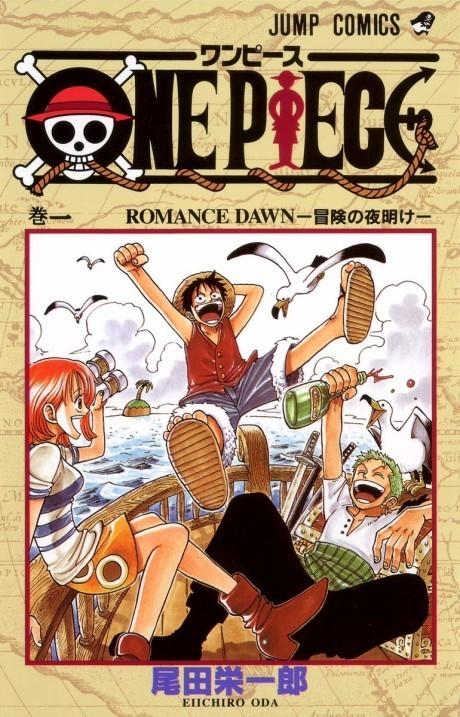
The numbers prove print is not dead. In 2024, One Piece volume 108 topped Oricon's annual manga ranking in Japan with 1,552,215 copies sold, and all 110 volumes of the series have crossed the one-million mark — a first in manga history, per Oricon. The takeaway: a single Japanese print series can still outsell everything else in its home market.
If you need a refresher on why One Piece remains untouchable, read the One Piece chapter 1182 analysis — because a single Oda chapter is still an event.
Manhwa — Korea, vertical webtoons, and the Solo Leveling leap
Modern Korean manhwa is a different animal. It is built around the webtoon format: vertical scroll, full color, chapters designed from the first panel for the phone rather than the printed page. Top to bottom, chapter by chapter, one thumb sliding the screen.
Solo Leveling: from web novel to anime in 200 territories
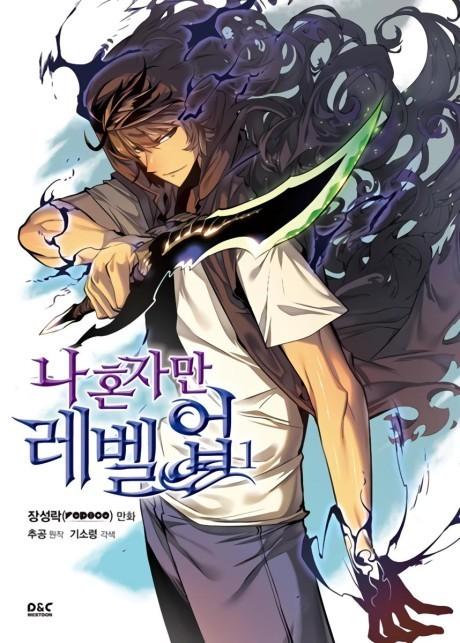
The clearest example of Korean manhwa's leap into the mainstream is Solo Leveling. It began as a web novel by Chugong on KakaoPage in July 2016, was adapted into a manhwa by artist Jang Sung-rak (known as DUBU) of Redice Studio in March 2018, and concluded its main arc in 2021, per Wikipedia.
Then came the inflection point: the Solo Leveling anime premiered on Crunchyroll across 200 territories simultaneously on January 6, 2024 — the first anime adapted from a Korean manhwa to receive global distribution at that scale, per Crunchyroll. It fused the global webtoon readership with the global anime audience in a single wave, and turned the series into something even non-readers now recognize.
WEBTOON Entertainment on Nasdaq — $2.9 billion at the bell
The industrial shift is bigger than a single series. WEBTOON Entertainment — the parent of Naver Webtoon, LINE Manga, Wattpad, and Tapas — listed on Nasdaq in June 2024 under the ticker WBTN at an opening price of $21, closing its first session at $23 with a market cap of roughly $2.9 billion, per Fast Company.
In its full-year report, WEBTOON booked record revenue of $1.35 billion in 2024 with a record adjusted EBITDA of $67.9 million and roughly 166 million global monthly active users, per Anime News Network. And it is not an outlier: Tower of God, which launched as a Korean webtoon on Naver in 2010, has surpassed 5 billion views on the platform per recent reporting, and its anime returned for a second season on Crunchyroll on July 7, 2024, per Crunchyroll.
For a closer-to-home view, see the most popular manhwa of 2026 — seven of the top ten series our readers are following in 2026 are Korean manhwa, not Japanese manga.
Chinese manhua — the largest market the rest of the world barely reads
Here is where most foreign readers do a double-take. Chinese manhua is the third leg of the stool, and the least visible one outside China. It is usually published digitally and in color, read left to right in its modern editions, and dominated by a single domestic giant: the Kuaikan Manhua app.
The scale is genuinely surprising. By the end of 2024, Kuaikan Manhua had become the dominant hub for digital manhua in China with more than 340 million registered users and roughly 50 million monthly active users, commanding more than 50% of the Chinese manhua market, per Business Model Canvas Template. The broader Chinese comic market was worth $2.44 billion in 2024 and is projected to grow at a 10.7% CAGR through 2033, with the digital segment as the fastest-growing slice, per Grand View Research.
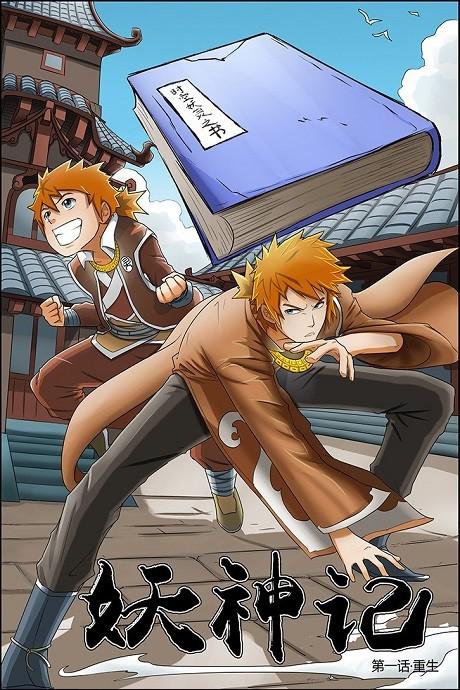
What does cross over usually arrives through English translations, often months after the original, and tends to cluster around the xianxia (immortal-cultivation) and rebirth subgenres. Tales of Demons and Gods is the example most readers outside China have encountered. This is less an indictment of the art than of a distribution infrastructure that has never been built for export.
Why the difference matters in 2026: the industries are redrawing the map
What makes this distinction matter today — and not five years ago — is that the three industries are redrawing the map in real time, and each is creeping onto the others' turf.
Shueisha enters the webtoon world via Jump Toon
In May 2024, Shueisha — the legendary publisher of Weekly Shōnen Jump — launched Jump Toon to publish comics in full-color vertical Webtoon format, through its Toon Factory subsidiary, per KComicsBeat. It is an explicit acknowledgment from the most storied manga publisher in Japan that the Korean format now governs the phones of younger readers.
The Disney + WEBTOON deal: 100 titles from Marvel and Star Wars, vertically
In 2025, WEBTOON announced a global partnership with Disney to release roughly 100 titles from Marvel, Star Wars, 20th Century Studios, and Disney in vertical Webtoon format, per Anime News Network. The practical translation: even Spider-Man will be read with a thumb scrolling the screen. The Korean format has become a cross-geography industrial standard.
About 74% of webtoon reading time happens on phones — and the phone does not love black and white
Roughly 74% of global webtoon reading time in 2025 happens on smartphones, per Mordor Intelligence. That single figure explains a lot: the vertical-scroll format is engineered around mobile browsing habits, while print manga was designed for black-and-white pages held in two hands. When the market grows on the phone, the format designed for the phone wins by default.
For a vivid example of the format crossing industries: The Beginning After The End started as an American web novel by TurtleMe on Royalroad in 2015, migrated to Tapas (owned by Kakao Entertainment) in 2017, and has been published as a webtoon since 2018, per Wikipedia. "Manhwa" is no longer a nationality. It is a format.
For a view from the streaming side of the same shift, read how Crunchyroll is riding the manhwa wave.
A short summary and what to read next
The simplest test for what is in front of you comes down to three questions: What color is the chapter? Which direction does it scroll? What platform is it on?
- Manga = Japan, black and white, read right to left, printed volume.
- Manhwa = Korea, full color, vertical scroll, the Webtoon app or its siblings.
- Chinese manhua = China, color, read left to right, a domestic app like Kuaikan.
Three follow-up reads on MangaTime to complete the picture:
- A guide to the best 10 manhwa on MangaTime — the lowest-friction starting point if you want to try the Korean format.
- Viral Hit lands on Netflix — the power of Korean manhwa — a case study in how a manhwa becomes a multi-platform visual event.
- Gachiakuta and the One Piece throne — a reminder that Japanese manga keeps producing fresh heirs, even in the age of the webtoon.
Bookmark this piece — we'll update it with every major industry shift in 2026.