
At 2 a.m., a reader in Riyadh opens her phone, hunting the next chapter of a manhwa she started a week ago. The chapter dropped hours ago in Korean, sits on Webtoon in English, and has a scattered Arabic translation across three Telegram groups. Not one Arabic manga app pulls all of that into a single place and respects her time. That is the precise gap MangaTime sets out to close — an Arabic-first, free app for reading manga and manhwa, officially launched in 2026 by the developer marmarisa, weighing in at no more than 8 MB, with a posted policy: no subscriptions, no paid features, no popup ads. This isn't a review with a marketer's conscience. It's an editorial read of what the app actually does — and what it doesn't do yet.
Why the Arabic reader needs an app of their own in 2026
The numbers tell the story before we do. The global manga market hit roughly $19.35 billion in 2025 and is projected to jump to $47.82 billion by 2030 at a compound annual growth rate of about 19.83% — with digital format alone expected to capture more than 70% of the market by the end of the decade, per a Mordor Intelligence report. The webtoon market, meanwhile, jumps from $10.75 billion in 2025 to $14.02 billion in 2026, at annual growth nudging 30.5%.
And yet, despite all that scale, the Arabic reader stays off the board. Webtoon — which serves 155 to 170 million monthly active users across more than 150 countries — officially supports nine languages: Korean, Japanese, English, Thai, Spanish, French, German, Indonesian and Chinese. Arabic is not among them. On the other front, Shueisha's MANGA Plus — home of One Piece and Jujutsu Kaisen — also supports nine languages, none of them Arabic, despite years of reader requests.
The Middle East and Africa account for roughly 5% of the global webtoon market, and most of that is readers consuming in their native language on a smartphone. Reading here doesn't happen on a desktop in an office. It happens on the bus, in the grocery line, in bed before sleep. When 70% of the market is digital by the end of the decade, per Mordor's forecast, the device carrying the content is the phone — and nothing else.
That creates a two-sided equation: an active reader on a lightweight phone, and major platforms that don't speak the language. The gap isn't on the demand side. It's on the supply side. And across the Pacific, it seems no one has noticed yet.

MangaTime in a single line
On Google Play, the app's name is "مانجا تايم - مانجا ومانهوا," under the identifier org.mangatime.app, shipped by the developer marmarisa. Version 1.0, last updated May 17, 2026, package size around 8 MB, classified under Social. The app is an extension of an editorial project already running at mangatime.app, which describes itself as "an Arabic magazine for manga and manhwa — trusted editorial coverage, translated work, and a discovery library curated by actual readers," under the tagline: "Manga is told visually; we tell it in Arabic." The official download page leaves no room for confusion: "no subscriptions, no paid features, no popup ads."
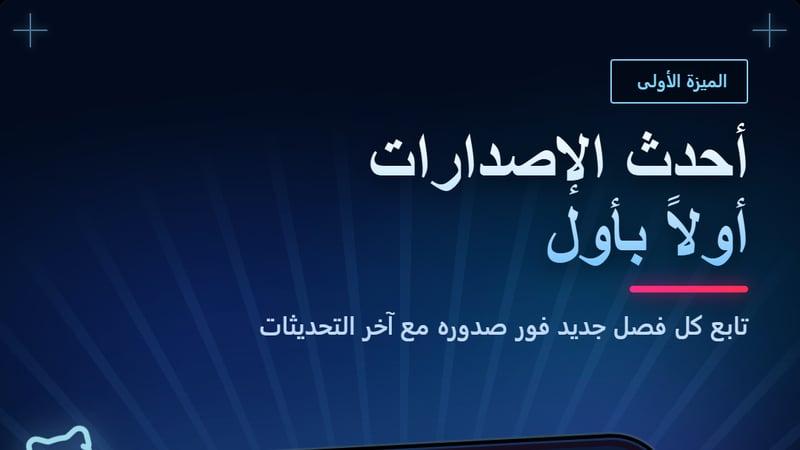
What sets MangaTime apart from the alternatives
The core question isn't "does this app do what Webtoon does?" — because it doesn't try to. The question is: what works for an Arabic reader on a modest phone at 2 a.m.? Six points capture the difference.
Arabic from the first line, not a translated afterthought
The difference between an app born Arabic and one translated into Arabic is something a reader spots in under two minutes. Right-to-left browsing, chapters that page in the correct direction, native Arabic typography rather than a Latin fallback, and terminology written the way Arabic manga readers actually write it.
Free, no subscriptions, no popup ads
Lifted verbatim from the official download page: "No subscriptions, no paid features, no popup ads." That's a public commitment, not a buried setting. No paywall on the next chapter, no 30-second video before launch.
A library that pulls manga and manhwa into one app
Splitting Japanese manga and Korean manhwa across two apps is a legacy assumption — one publishers made, not readers. MangaTime puts both under one roof, which is exactly how readers think about them already.
Chapters actually translated, not an Arabic shell over English content
The distinction marketing pages tend to ignore: an Arabic interface is not the same as translated content. MangaTime builds on an existing editorial operation, meaning there are series genuinely translated into Arabic — not "Read" buttons that just hand you an English PDF. For readers looking to extend their list after install, our guide to the top 10 manhwa on MangaTime is a respectable starting point.
Cloud sync between web and app
Start a chapter on the site in your browser, leave it on the line where you stopped, open the app on your phone later — and it picks up where you left off. A small feature, but it solves a daily problem most competitors ignore. The Play listing says it directly: a personal library with reading states (Reading / Completed / On hold / Saved) and new-chapter alerts.
A light footprint that respects your data and your time
The 8 MB size isn't a footnote. In the mid-tier Arabic phone market — where apps compete over a 64 GB cap — the gap between 8 and 80 MB is the gap between an app that stays and an app that gets uninstalled after a week. The system requirements are modest in kind: Android 8 and above, iOS 13 and above — which means it reaches the broadest slice of Arabic readers, not just the high end.
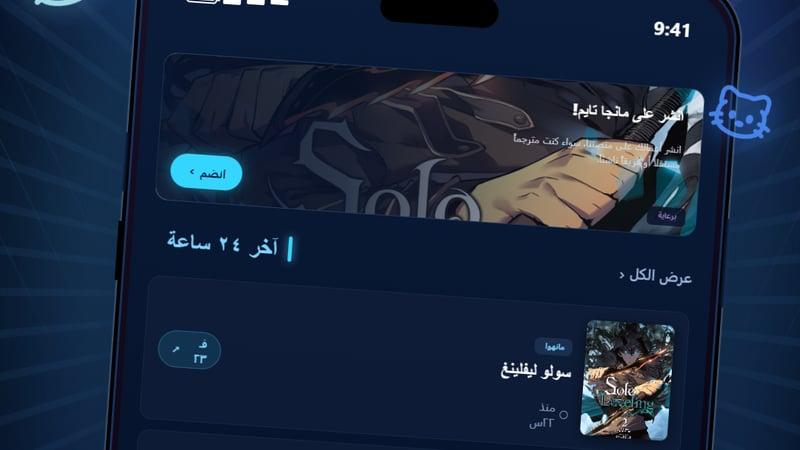
How to start in under a minute
Setup isn't a journey. Five steps, one minute from launch to your first chapter.
Start reading on MangaTime in a minute
From installing the app to your first chapter — short steps, no account needed.
Download the app
Grab it from Google Play on Android 8 and above, or from the App Store on iOS 13 and above. The package is ~8 MB and runs even on a slow connection.
Open the app
No account required to read. The app opens straight to the discovery screen, and you can browse the library without any sign-up.
Pick Arabic
If your language isn't auto-detected from system settings, pick Arabic from the language list on the first screen. English is also available for bilingual readers.
Browse the library
Pick a Japanese manga or Korean manhwa from the home screen, tap the first chapter, and start. Manga reads right-to-left; webtoons read top-to-bottom.
Sign in (optional)
If you want cloud sync between phone and browser and want to save reading progress across devices, create an account. The step is entirely optional and doesn't affect available content.
For a direct Android download, grab it from Google Play — the official developer page, not a sketchy APK mirror.
What follows 2026: the published roadmap
Honest writing toward a reader means naming what's available today and what's a promise for tomorrow. The languages actively supported in the MangaTime app and site right now are exactly two: Arabic and English. That's it. Korean, Japanese and Chinese are listed on the official download page as "coming soon," with no announced date. Anyone who needs them today won't find them today — and that needs to be said this clearly.
What hasn't shipped yet either: fully documented offline reading, a Web Reader that mirrors the app's full feature set, an iPad and Tablet build optimized for larger screens. All of them are on the table; none of them are in your hand right now.
Version 1.0 isn't a flaw to hide; it's a marker of an app that shipped today. If the version were 5.7 and the package 80 MB and the feature list filled a whole page, that would be the signature of a product piled with layers nobody needed. Here, the restraint is intentional.
Quick comparison: MangaTime vs. the alternatives
Three platforms dominate the conversation, and MangaTime doesn't compete with any of them on their own field. The table below isn't a "which is best" — it's a "which one suits whom."
| Platform | Supported languages | Model | Arabic coverage |
|---|---|---|---|
| Manga Plus | 9 languages (English, Spanish, French, German, Russian, Thai, Portuguese, Indonesian, Vietnamese) | Fully free | No Arabic support as of May 2026 |
| Webtoon | 9 languages (Korean, Japanese, English, Thai, Spanish, French, German, Indonesian, Chinese) | Free + Fast Pass | No Arabic support |
| Crunchyroll Manga | English only | Paid premium add-on, U.S. and Canada only | No mention of Arabic on the roadmap |
| MangaTime | Arabic, English | Free, no subscriptions, no popup ads | The foundation |
Against Manga Plus, the math is clear: Shueisha hands its own platform content nobody else has — One Piece's same-day chapter, Jujutsu Kaisen a week before any Arabic translation arrives. The cost: you read it in English. MangaTime can't match that slate of official content, but it can do something else — speak your language.
Against Webtoon, competing on the size of the Korean catalog is hopeless: 170 million monthly users build an entire ecosystem. Against Crunchyroll Manga — relaunched on Oct. 9, 2025 as a paid add-on subscription in English only across the U.S. and Canada — there's no competition to speak of: the Arabic reader sits outside the eligible geography. For anyone who wants to dissect the broader picture, see our analysis of Crunchyroll's structural problems.
The verdict: MangaTime isn't playing on the field of scale. It's playing on the field of language and culture, and that field is empty in 2026. For more context, follow the latest manga and manhwa news weekly, and Lelouch's editorial coverage goes deeper on industry questions, while the file on the top 5 manhwa of 2026 — by the numbers maps what's actually being read this year.
Bottom line: who we recommend it for, and who we don't
The app isn't for every reader, and it doesn't claim to be. We recommend MangaTime if you read primarily in Arabic, hate ads and subscriptions in equal measure, want manga and manhwa in one app instead of bouncing across three, and your phone isn't the latest flagship. Those four conditions describe most Arabic readers — not a minority of them.
We'd hold off if your reading list revolves around instant Shueisha releases — same-day One Piece, Jujutsu Kaisen in the first hour. MangaTime doesn't hold the Manga Plus rights and won't anytime soon. Hold off, too, if you need Korean or Japanese as a reading language rather than just an interface — those are on the roadmap, not in your hand.

The bottom line, unvarnished: an Arabic, light, honest, genuinely free app. Test it for a week before you decide — and if your experience tracks anywhere close to ours, it'll stay. If it doesn't, there's no real cost: 8 MB deletes in a second.